About this place
Iguazu Falls are a system of waterfalls on the Iguazu River, located on the border of the province of Misiones in Argentina and the state of Paraná in Brazil. The falls are the centerpiece of two national parks: Iguazú National Park in Argentina and Iguaçu National Park in Brazil, both of which are designated UNESCO World Heritage sites. The nearest city on the Argentine side is Puerto Iguazú, which has a population of approximately 82,000.
Historical Outline
The area was originally inhabited by the Guaraní people, and the name "Iguazú" comes from their language, meaning "big water." The first European to record the existence of the falls was the Spanish conquistador Álvar Núñez Cabeza de Vaca in 1541. For centuries, the remote location kept the falls largely isolated. In the early 20th century, both Argentina and Brazil established national parks to protect the falls and the surrounding subtropical rainforest.
Physical Characteristics
The falls are not a single cataract but a chain of hundreds of individual waterfalls and cascades spread out over approximately 2.7 kilometers. While the falls are shared by both countries, about 80% of the drops are on the Argentine side. This unique formation is the result of the Iguazu River flowing across a series of basalt layers of varying resistance to erosion.
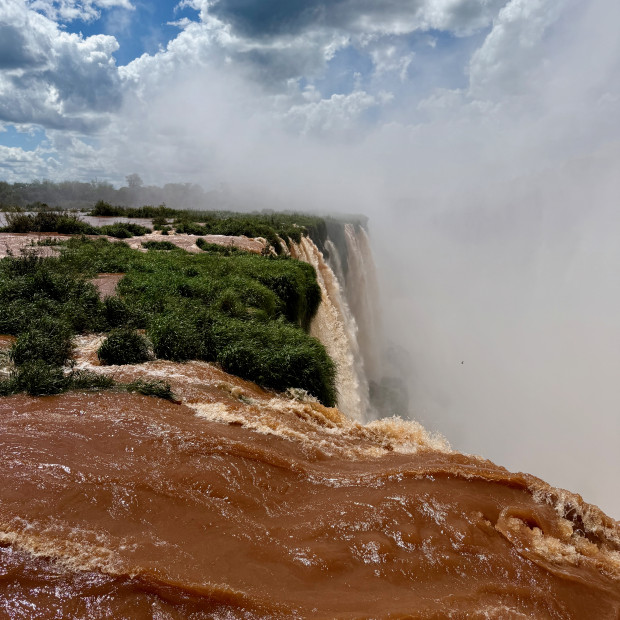
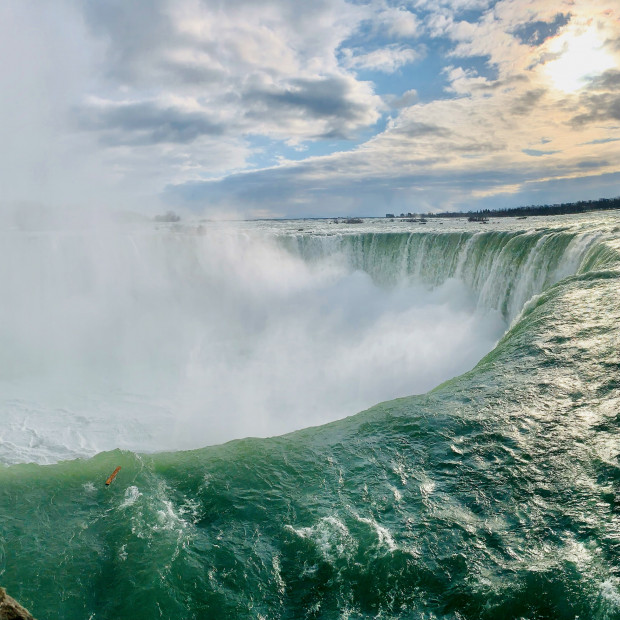
The flow of water over the falls can vary dramatically depending on the season and rainfall in the river basin. On average, about 1,756 cubic meters of water flow per second. The highest and most powerful of the falls is a U-shaped chasm known as the Garganta del Diablo, or Devil's Throat. This section is approximately 82 meters high, 150 meters wide, and 700 meters long. It marks the main border between Argentina and Brazil and is where nearly half of the river's total flow plunges into the abyss below, creating a permanent, thick cloud of mist.
The Argentine Side Experience
The park on the Argentine side is designed to provide an immersive and close-up experience with the waterfalls. An extensive network of walkways and trails allows visitors to walk directly over and alongside the various drops. The park is divided into several circuits. The Upper Circuit (Paseo Superior) offers panoramic views from the top of the waterfalls, while the Lower Circuit (Paseo Inferior) brings visitors closer to the base of the falls, where the power of the water can be felt.
A dedicated ecological train transports visitors through the park to the station for the Garganta del Diablo. From there, a long, flat metal walkway extends for over a kilometer across the wide, calm expanse of the upper river, leading directly to the edge of the main chasm. This approach builds anticipation before revealing the immense power and deafening roar of the Devil's Throat, where the water crashes down on three sides. This intimate perspective contrasts with the more panoramic views offered from the Brazilian side.