About this place
Ipanema is a neighborhood located in the South Zone (Zona Sul) of the city of Rio de Janeiro, Brazil. It is situated between the famous neighborhoods of Copacabana to the east and Leblon to the west. Ipanema is known as one of Rio's most affluent and socially sophisticated areas, characterized by its grid-like streets lined with upscale boutiques, restaurants, and art galleries, alongside residential apartment buildings.
The Beach and its Culture
Ipanema Beach is a long, wide stretch of sand that is famous for its social scene and cultural significance, immortalized in the bossa nova song "The Girl from Ipanema." The beach is unofficially divided into sections demarcated by lifeguard towers known as postos. These postos serve as social landmarks, with different sections of the beach attracting specific crowds. For example, Posto 9 has a long-standing reputation as a gathering spot for artists, intellectuals, and a younger, more alternative crowd.
The beach runs parallel to Avenida Vieira Souto and features a distinctive black and white patterned promenade. It is a central hub for recreation for residents and visitors, with activities ranging from sunbathing to sports like foot-volley, surfing, and beach volleyball.
Morro Dois Irmãos (The Two Brothers Mountain)
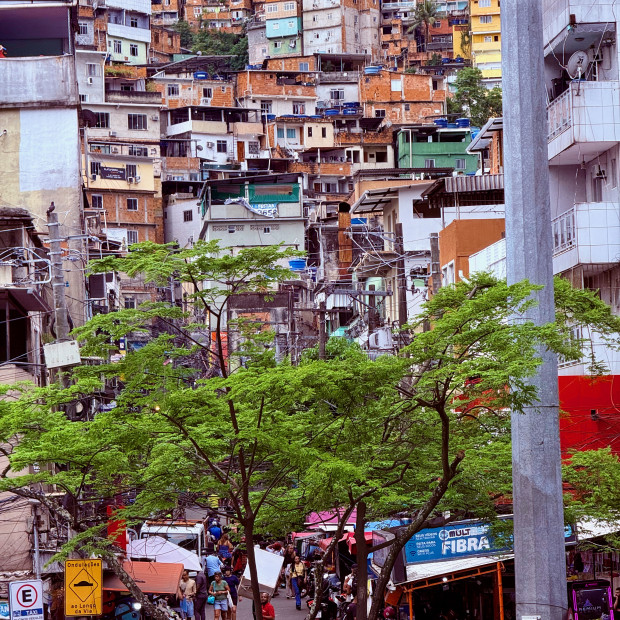
The western end of the continuous shoreline of Ipanema and Leblon is framed by the dramatic profile of Morro Dois Irmãos, or "Two Brothers Mountain." This is a prominent granite rock formation that rises to an elevation of 533 meters (1,749 feet). As its name suggests, the mountain is characterized by two distinct peaks, with one being slightly taller than the other. The mountain is not only a natural landmark but also a socio-geographic one, as the large community of the Vidigal favela is located on its slopes.
The Legend of the Two Brothers
The name of the mountain is rooted in an indigenous Tupi-Guarani legend that predates the arrival of Europeans. According to the folklore, two brothers from the same tribe fell into a bitter conflict, often said to be over the love of a woman or a transgression against tribal laws. Their fighting angered the great god Tupã, who, in his fury, created a massive storm and a great flood to punish them. As the waters rose, the two brothers were turned into stone, forming the two peaks of the mountain. They were left as a permanent, silent reminder to all future generations of the destructive consequences of conflict and discord within a family or community.